
By: Kwabena Owusu Amoateng & Akua Afrakoma Osei
August 15, 2025
The Problem
As we approach the end of the course, our collaboration with Community Futures has shifted from concept to refinement, guided by our central theme of Community Capacity Building. Stakeholder consultations revealed three core challenges shaping our initial Excel database design: the absence of dedicated personnel, the lack of a user-friendly management reporting system, and the absence of accessible repositories for past—yet rarely replicated—projects. These findings underscored the need for a tool that is simple, quick to use, and easy to maintain, while also enhancing Community Future’s ability to capture and share project outcomes and impacts. Historically, reporting to funding partners has relied heavily on numerical summaries, with little narrative context to convey the broader impact of initiatives. Our proposed framework may help to address these gaps by combining efficiency and user friendliness with the capacity for interpretive storytelling, enabling richer, more meaningful insights that can strengthen organizational and community capacity alike.
What is it informing
During our recent discussions with Community Futures, we were introduced to TEA (The Exceptional Assistant)—a comprehensive database system used across many CF offices nationwide. While TEA is designed to accommodate a wide range of project types and organizational needs, discussions with staff revealed that its potential is often underutilized, with its current use largely limited to tracking client records and financial data. This underuse is not due to the system’s limitations, but rather how it is being utilized by personnel. In response, and in alignment with our focus on Community Economic Development (CED) and Community Capacity Building, our Excel-based database adopted a dropdown menu system as a way to describe CED projects. The dropdowns have pre-suggested categories to add easy updates for the projects. Since the TEA in general captures all types of projects, the Excel is tailored specifically towards CED projects. So far, this typology has been populated with five verified CED projects, with 15–20 expected upon completion.
What’s New
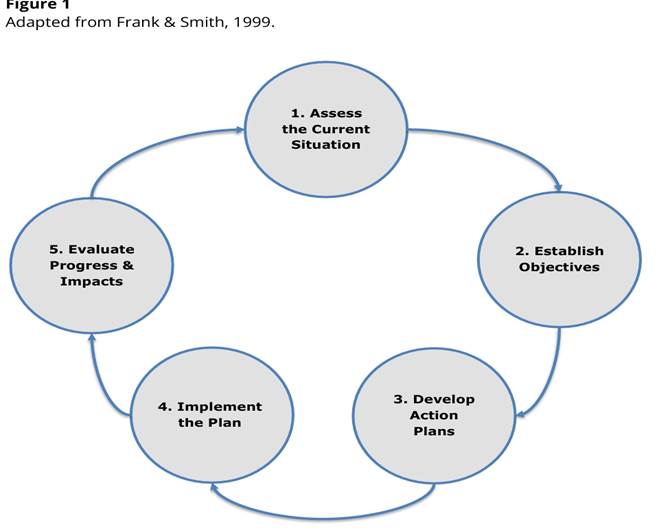
When we reviewed CF Westman’s application forms—one of the main data sources for our project—we noticed that while they consistently captured business details, they revealed little about applicants’ capacity requirements. Conversations with CF added another layer to this picture: capacity building efforts have largely been directed outward, focusing on client consultations led by Wendy Petersen, CF’s Community Development Analyst. This insight stood out because capacity building is often framed in terms of skills and other “tangible” or measurable abilities. Yet, as Ekezie and Tugwell (2019) remind us, “Building capacities also entails building abilities, relationships and values that will enable organizations, groups and individuals to improve on their performances and achieve effectively, their developmental objectives.” This broader view resonates with Stages 1–3 of the Community Development Cycle (see Figure 1), which highlight “expanding the knowledge, skills and abilities of community members and organizations required to address community needs and development priorities” (McNeely & Kelly, 2024, p. 4).
Stay tuned for our final blog!
Reference:
Ekezie, A. I. A., & Tugwell, O. O. (2019). Assessment of the capacity building needs of agricultural science teachers for innovative instructional delivery in secondary schools in Rivers State, Nigeria. INVOTEC, 15(2), 43-57.